Wipeout!
You don't need a weather man to know which way the wind blows.
- Bob Dylan
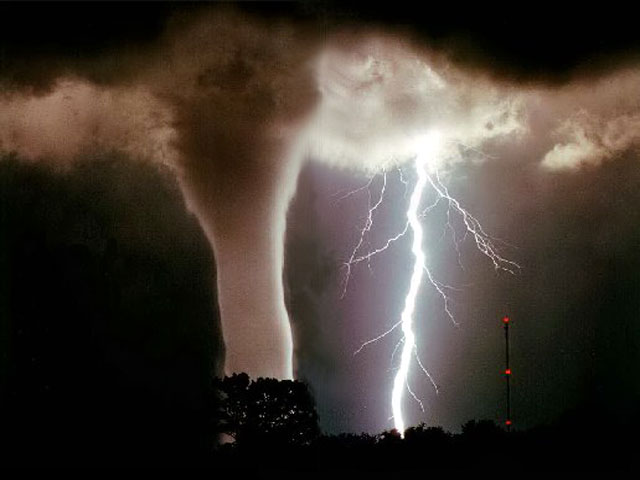
Source: www.ees-group.co.uk
Electrical Discharges inside Tornados
Any farmer from America's "tornado alley (Oklahoma and Kansas, primarily)" will testify to the extreme violence of a tornado vortex.
Tornados are associated with electrical storms. Scientists have been arguing for years as to whether storm electricity helps spawn tornados and whether electrical effects are
important attributes of the funnels. The first eyewitness account is descriptive of obvious electrical activity inside a funnel. The second bit of testimony is even more
interesting since it describes long vertical light columns (like "neon tubes) associated with tornado funnels. The tubes tie in with occasional observations of aurora-like columns
above distant thunderstorms.
A farmer living near Greensburg, Kansas on 22 June 1928 had the rare "privilege" of looking right up into a tornado funnel while standing at the entrance of his cyclone cellar.
"As I paused to look I saw that the lower end, which had been sweeping the ground, was beginning to rise. I knew what that meant, so I kept my position. I knew
that I was comparatively safe and I knew that if the tornado again dipped I could drop down and close the door before any harm could be done.
"At last the great shaggy end of the funnel hung directly overhead. Everything was as still as death. There was a strong gassy odor and it seemed that I could not
breathe. There was a screaming, hissing sound coming directly from the end of the funnel.
"I looked up and to my astonishment I saw right up into the heart of the tornado!
"There was a circular opening in the center of the funnel, about 50 or 100 feet in diameter, and extending straight upward for a distance of at least ½ mile, as best I could judge
under the circumstances. The walls of this opening were of rotating clouds and the whole was made brilliantly visible by constant flashes of lightning which zigzagged from side to
side." (Monthly Weather Review, 58: 205, 1930)

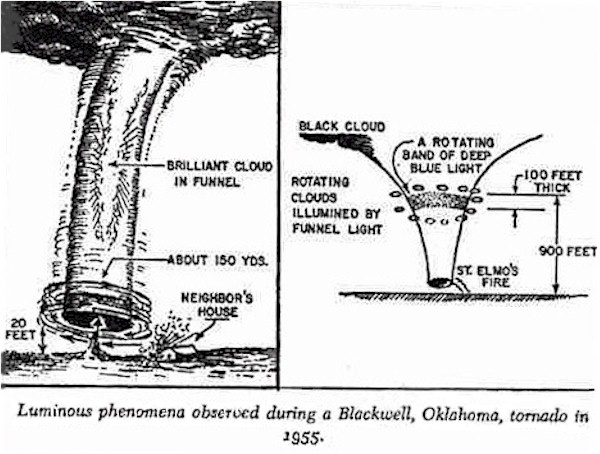
The 25 May 1955 tornado at Blackwell, Oklahoma, was a particularly strong tornado. Lee Hunter saw the light-column effect vividly.
"The funnel from the cloud to the ground was lit up. It was a steady, deep blue light - very bright. It had an orange color fire in the centre from the cloud to
the ground. As it came along my field, it took a swath about 100 yards wide. As it swung from left to right, it looked like a giant neon tube in the air or a Bagman
at a railroad crossing. As it swung along the ground level, the orange fire or electricity would gush out from the bottom of the funnel, and the updraft would take it up
in the air causing a terrific light - and it was gone!" (Journal of Meteorology, 14:284, 1957)
Source: Handbook of Unusual Phenomena: Eyewitness Accounts of Nature's Greatest Mysteries by William R Corliss

Plains Tornadoes Rich in Research Data
by Kelly Kurt
Norman, Oklahoma - The vision of scientists taming deadly storms isn't anything more than a pipe dream, researchers say. They don't even know yet how giant tornadoes are
born. But a University of Oklahoma researcher who trailed the funnels that killed 41 people last week predicts more may be learned from that May 3 evening than a decade of storm
chasing.
"We're going to make quantum leaps, I think - I hope," professor Howie Bluestein said Tuesday.
President Clinton, viewing the ruins Saturday of neighbourhoods swept away in the storms, suggested seeing if the "frontiers of science can widen to the point where we can dilute the
strength of the storm." He said, "We'll put Oklahoma at the centre of that."
But it's unlikely the strength of storms is something that can - or should - be tamed, said Harold Brooks, research meteorologist at the National Oceanic and Atmospheric
Administration's National Severe Storms Laboratory in Norman. Tornadoes spin from thunderstorms that hold the energy of "an atomic bomb explosion per second," he said. "If
we take that option away from the thunderstorm, it may respond in some way that is even less friendly than a tornado." Even if the technology existed, Brooks doubts taxpayers
would support the cost of maintaining the equipment, such as a fleet of aircraft, to attack and dilute storms.
The tornado that hit the Oklahoma City suburbs last week reached wind speeds of 318 miles an hour, according to readings taken by one of the University of Oklahoma's Doppler on Wheels
radar trucks. It was rated F-5 on the Fujita scale, the highest ranking for twisters.
Two teams led by Joshua Wurman, an assistant professor in the meteorology department and head of Oklahoma University's storm-tracking unit, intercepted the storm system that afternoon
west of Lawton and trailed its path past Oklahoma City. Later that night, the team followed a mile-wide tornado that ploughed through the town of Mulhall. "We had one radar
watch a powerful tornado be born," Wurman said. "That's another piece of the puzzle."
Down the hall from Wurman's office, Bluestein pointed to an image recorded by another Doppler radar on the truck his team drove near the storm. Tiny dots appear in the centre of
a mass of swirling red and blue that show varying wind speeds. "These were small tornadoes within the large cone," he said. The radar image might help explain phenomenon such
as a mobile home in Bridge Creek that was sucked away by a tornado while lawn chairs sat undisturbed nearby.
Bluestein, who has been tracking tornadoes across the prairie since 1977, said it could take months or even years to interpret all the data collected that evening. "I don't
think we're ever going to be able to modify tornadoes," he said. "We still need to understand how tornadoes form." If researchers can do that, Brook said, they might be
better able to predict intensity and tailor storm warnings accordingly.
"My house takes an F-1 tornado. In an F-3 tornado, our interior hallway is almost certainly survivable, although we may lose a good part of the house," Brooks said. "In an
F-5 tornado, we're dead if we're there."
Source: NansoTimes 12 May 1999 © Nando Media and Associated Press
Armoured Tornado Camera Destroyed - by a Tornado
A camera specially designed to take pictures of the inside of a tornado has been destroyed - by a tornado. National Geographic constructed the armoured device and placed
it in the path of a storm near Manchester, South Dakota. But it was blown away within seconds when the tornado hit. The remains were found stuck in mud more than 430 feet
away. All the device's glass ports were smashed and the cameras inside were ruined, National Geographic said. The film was being sent back for processing just in case, but
officials said they doubted it captured any images.
Source: www.ananova.com Thursday 26 June 2003 © Associated Press
Tuesday 4 May 1999: I don't think I experienced this day at all. I'm wondering if maybe New Zealand skipped this day. I think Oklahoma wishes they had. Instead, the
region was crisscrossed by 76 tornadoes, one of which reached the dreaded Force 5 and killed more than 50 people. (And this is still before the expected "rapid climate change"
hits!)
Tornado Photos
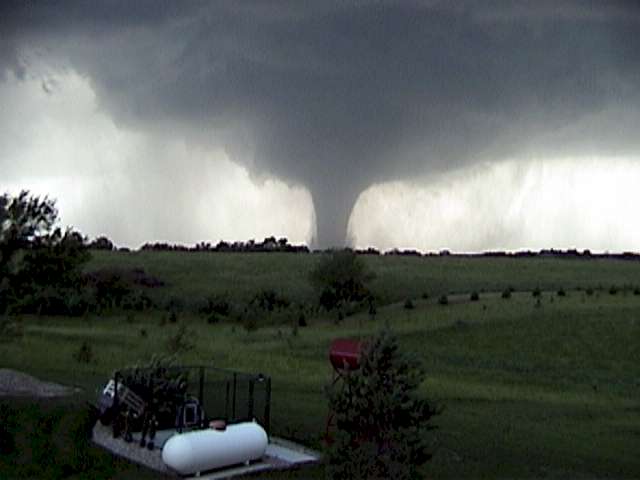
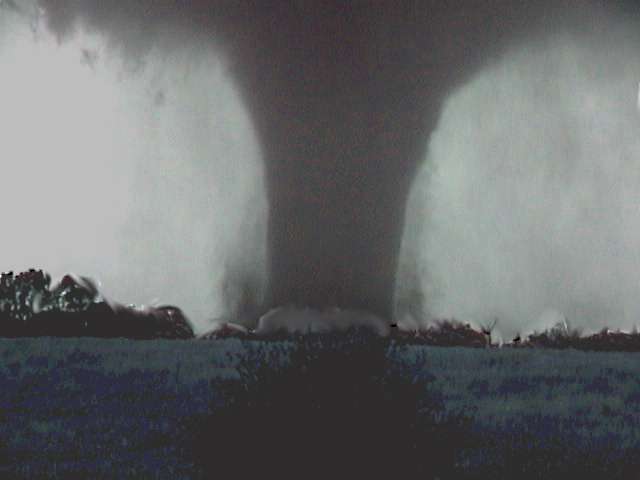
The last picture was taken less than a mile from the tornado.
The monastery of Carmel of Jesus, Mary, and Joseph in Valparaiso, Nebraska, is about 10 miles to the right.
Source: www.lasvegasmariancenter.com 15 June 2001
Also see:
 | A Turn for the Worse - a diagram showing how tornados work. It is somewhat slow to load but informative. |
| 'Tis the Season to Be Swept Away the next page in this section) - The US is the country with the highest frequency of tornadoes - every
state has recorded at least one in its past (although they are extremely rare in Alaska)... |
| Controlling the Weather (the second page following) - "We call it taming the tornado - with just a little burst of microwave energy, we
think we see a way to negate the trigger point in tornado creation. We want to heat the cold rain..." |
| A Whirlwind Tour of Miami - A spectacular photo... |
| Winds of Change (earlier in this section) - A full-fledged hurricane is a vast self-sustaining heat engine 100 times larger than a
thunderstorm and 1,000 times more powerful than a tornado. An ordinary summer afternoon thunderstorm has the energy equivalent of 13 Nagasaki-type atomic
bombs. Most hurricanes have at least 25,000 times that potential for destruction. One storm in 1928 dropped 2,500 million tons of water on Puerto Rico in just two
hours, but this was in fact only a fraction of its total capacity. An average hurricane precipitates about 20,000 million tons of water a day, which represents the
energy equivalent of half a million atom bombs... |
| Hurricane (the previous page in this section) - Hurricane activity runs in cycles, influenced by the ocean's salt content, currents and water
temperature. Their "busy period" is caused by a cyclical rise in salt content. Higher salinity changes the ocean currents, which, in turn, makes water temperatures
rise. Hurricanes draw their strength from warm water... |
| A Tremulous Motion and Preparing
for the Inevitable (in the section on Wellington) - about Wellington earthquakes past and future. |
| Enlightening Lightning (further in this section) - Lightning may seem relatively rare, but there are about a hundred flashes a
second around the planet. Ground strikes almost always create currents in the surrounding soil... |
For pages on natural disasters - including the above-mentioned lightning strikes, volcanoes and hurricanes but also global warming and more - as well as satellite photos and
some great pictures of trees, clicking the "Up" button immediately below takes you to the Table of Contents page for this Environment section.
|  Animals
 Animation
 Art of Playing Cards
 Drugs
Drugs Education
 Environment
 Flying
 History
 Humour
 Immigration
 Info/Tech
 Intellectual/Entertaining
 Lifestyles
 Men
Men Money/Politics/Law
 New Jersey
 Odds and Oddities
 Older & Under
 Photography
 Prisons
 Relationships
 Science
 Social/Cultural
 Terrorism
 Wellington
 Working
 Zero Return Investment