Birthing Pains
Shouldn't a great museum foster serious seeing before all else?
- Mark Stevens
In a museum in Havana there are two skulls of Christopher Columbus,
one when he was a boy and one when he was a man.
- Mark Twain
You know... that a blank wall is an appalling thing to look at:
the wall of a museum - a canvas - a piece of film - or a guy sitting in front of a typewriter.
Then, you start out to do something - that vague thing called creation. The beginning strikes awe within you.
- Edward Steichen
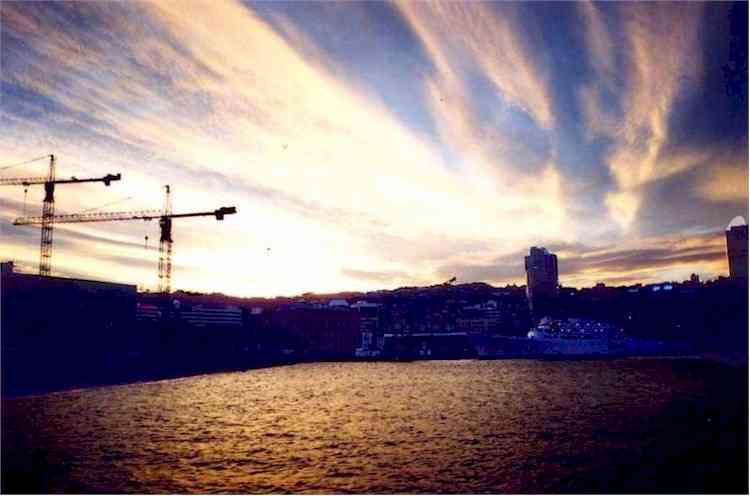
When this picture was taken, I recall that everyone in my family was eagerly awaiting the opening of Te Papa. It would be so close to us - so convenient to visit. We had
been to the museum on Buckle Street several times and had always thoroughly enjoyed it. We thought having a museum of such magnitude practically right next door would be heaven, a real learning
experience. As it eventuated, after Te Papa opened, we went there about 3 times before completely losing
interest.
We haven't been in over a year and the thought of going seldom, if ever, occurs to us anymore. Why not?
We think it's because Te Papa proved to be more of an entertainment centre and less of the enlightenment centre than we had been expecting. We were all disappointed in what we found there, though
I'm sure some of the patrons must like it.
Unfortunately, perhaps not enough. The museum loses money each year and looks to cost Wellington ratepayers millions annually to make up the shortfall. Oh well. Nothing is perfect,
right?

In Honour of the Museum, Here's a Little History...
"Facts" About the 1500s?
by Halvor Moorshead
For the last couple of years an item has been circulating around the Internet about so-called "Facts about the 1500s" (sometimes 1600s). A quick search using the search-engine Google
pointed to over 400 websites that were carrying this piece. Interesting reading. The problem is that most of it is completely invented. The original author is not credited in any of the
versions we have seen. Here the original version is presented first, then an attempt to correct the errors is shown in blue following.
The next time you are washing your hands and complain because the water temperature isn't just how you like it, think about how things used to be...
 | Most people got married in June because they took their yearly bath in May and still smelled pretty good by June. However, they were starting to smell so brides carried a bouquet of flowers to
hide the body odour. There is no evidence that June was a popular month to get married until the last 100 years. Flowers have been associated with weddings since the
earliest times, probably as symbol of fertility. |
| Baths consisted of a big tub filled with hot water. The man of the house had the privilege of the nice clean water, then all
the other sons and men, then the women and finally the children - last of all the babies. By then the water was so dirty you could actually lose someone in it - hence the saying, "Don't throw the
baby out with the bath water." This explanation makes no sense when you consider the expression and its meaning. Additionally bathing was so rare that there were no
bathing tubs. |
| Houses had thatched roofs - thick straw, piled high, with no wood underneath. It was the only place for animals to get warm, so all the dogs, cats and other small animals (mice rats, and bugs)
lived in the roof. When it rained it became slippery and sometimes the animals would slip and fall off the roof, hence the saying, "It's raining cats and dogs." A
believable explanation is given in Brewer's Dictionary of Phrase and Fable: mythology associated the cat with rain and the dog with wind. |
| There was nothing to stop things from falling into the house. This posed a real problem in the bedroom where bugs and other droppings could really mess up your nice clean bed. Hence, a bed
with big posts and a sheet hung over the top afforded some protection. That's how canopy beds came into existence. Canopy beds may have originated as a means of keeping
out flying insects but if you think about it, people rich enough to afford a canopy bed - a huge investment in the 1500s - would also be living in homes with proper ceilings. |
| The floor was dirt. Only the wealthy had something other than dirt, hence the saying "dirt poor." Probably correct - except that the expression is American - and
from centuries later. |
| The wealthy had slate floors that would get slippery in the winter when wet, so they spread thresh on the floor to help keep their footing. As the winter wore on, they kept adding more thresh
until when you opened the door it would all start sliding outside. A piece of wood was placed in the entryway, hence, "a threshold." The term threshold predates the
12th century according to the Merriam-Webster Collegiate Dictionary. And isn't wet straw at least as slippery as wet slate? |
| They cooked in the kitchen with a big kettle that always hung over the fire. Every day they lit the fire and added things to the pot. They ate mostly vegetables and did not get much
meat. They would eat the stew for dinner, leaving leftovers in the pot to get cold overnight and then start over the next day. Sometimes the stew had food in it that had been there for quite
awhile - hence the rhyme, "peas porridge hot, peas porridge cold, peas porridge in the pot 9 days old." According to the Oxford Dictionary of Nursery Rhymes, this
chant was not used before 1762. |
| Sometimes they could obtain pork, which made them feel quite special. When visitors came over, they would hang up their bacon to show off. It was a sign of wealth that a man "could bring
home the bacon." They would cut off a little to share with guests and would all sit around and "chew the fat." We couldn't find a convincing explanation for chew the
fat. One was that it was of US Civil War origin, another that it was from Cockney Rhyming Slang meaning "have a chat" - and rhyming slang came was not known until after WWI. |
| Those with money had plates made of pewter. Food with a high acid content caused some of the lead to leach onto the food, causing lead poisoning and death. This
happened most often with tomatoes, so for the next 400 years or so, tomatoes were considered poisonous. It is true that tomatoes were thought to be poisonous until
about 1830 - however tomatoes were extremely rare in Europe in the 1500s and in any case are not acidic enough to affect pewter. |
| Most people did not have pewter plates, but had trenchers, a piece of wood with the middle scooped out like a bowl. Often trenchers were made from stale paysan bread which was so old and hard
that they could use them for quite some time. Trenchers were never washed and a lot of times worms and mold got into the wood and old bread. After eating off wormy mouldy trenchers, one would
get "trench mouth." The expression trench mouth was first used during WWI. |
| Bread was divided according to status. Workers got the burnt bottom of the loaf, the family got the middle, and guests got the top, or "upper crust." This one may
be true; the term upper crust does predate the 1500s. |
| Lead cups were used to drink ale or whiskey. The combination would sometimes knock them out for a couple of days. Someone walking along the road would take them for dead and prepare them
for burial. They were laid out on the kitchen table for a couple of days and the family would gather around and eat and drink and wait and see if they would wake up, hence the custom of holding a
"wake." A wake refers to what the visitors do, not what you expect the corpse to do! In this context a wake means a watch or a vigil. It originated from an
all-night watch kept in church before certain holy days. It later became associated with fairs and revelries held at such times. Some towns in the north of England still observe local holidays
called wakes. (Brewer's Dictionary of Phrase and Fable). |
| England is old and small and they started running out of places to bury people. So they would dig up coffins and would take the bones to a "bone house" and reuse the grave. When reopening
these coffins, one out of 25 coffins were found to have scratch marks on the inside and they realised they had been burying people alive. So they thought they would tie a string on the wrist of the
corpse, lead it through the coffin and up through the ground and tie it to a bell. Someone would have to sit out in the graveyard all night (the "graveyard shift") to listen for the bell; thus,
someone could be "saved by the bell" or was considered a "dead ringer." Saved by the bell is a boxing term dating from the 1930s and dead ringer is from horse racing about
1890 and refers to a horse - or somebody - who looks virtually identical to someone else. |
And that's the truth - whoever said that history was boring! History is not boring and the real explanations are just as interesting - and not hard to find either!
Source: history-magazine.com This article originally appeared in the February/March 2002 issue of History Magazine
Thanks to Laurie for bringing this to my attention.
See also:
| An Extraordinary World's Fair (in the Information and Technology section) - Computers and copiers in our offices,
microwave ovens in our kitchens, TVs in our living rooms, high-speed jets for travelling - every one of those technologies appeared in 1939... |
| Computers of a Bygone Era (also in the Information and Technology section) - for photos of computers in the 50s and for one
prescient electrical engineer's 's prediction of computers today. |
| 1962 Imagines 2001 (also in the Information and Technology section) - Back in 1962 - the year Seattle played host to the
World's Fair - humans were clearly primitive creatures who knew nothing of the wonders of the Internet or, for that matter, the wonders of the Post-It note (which wasn't invented until 1974)... |
| What Was Life Like a Century Ago? (in the section on Wellington) - The average life expectancy in the US was
47. Only 14% of US homes had a bathtub... |
| Order the Home of Your Dreams (in the Oddities section) - for an idea of what else could be ordered from the
Sears catalogue 100 years ago... |

Maybe These Are Really True?
| In Shakespeare's time, mattresses were secured on bed frames by ropes. When you pulled on the ropes the mattress tightened, making the bed firmer to sleep on. Hence the phrase "goodnight,
sleep tight." |
| It was the accepted practice in Babylon 4,000 years ago that for a month after the wedding, the bride's father would supply his son-in-law with all the mead he could drink. Mead is a honey beer
and because their calendar was lunar based, this period was called the honey month we know today as the honeymoon. |
| In English pubs, ale is ordered by pints and quarts. So in old England, when customers got unruly, the bartender would yell at them mind their own pints and quarts and settle down. It's
where we get the phrase "mind your P's and Q's" |
| Many years ago in England, pub frequenters had a whistle baked into the rim or handle of their ceramic cups. When they needed refill, they used the whistle to get some service. "Wet your
whistle" is he phrase inspired by this practice. |
| In Scotland, a new game was invented. It was entitled Gentlemen Only Ladies Forbidden.... and thus the word GOLF entered into the English language. |
Source: avolites.org.uk
For photos of the earth and moon, stained glass, sunsets on the Wellington Harbour, Lady Fair, Civic Square, the old mill, the Whippany River, historical houses, Lake Parsippany and more click
the "Up" button below to take you to the Index page for this Photographs section.
|
 Animals
 Animation
 Art of Playing Cards
 Drugs
Drugs Education
 Environment
 Flying
 History
 Humour
 Immigration
 Info/Tech
 Intellectual/Entertaining
 Lifestyles
 Men
Men Money/Politics/Law
 New Jersey
 Odds and Oddities
 Older & Under
 Photography
 Prisons
 Relationships
 Science
 Social/Cultural
 Terrorism
 Wellington
 Working
 Zero Return Investment